High-Yield Savings Account vs. Traditional Savings Account
At first glance, what is a high yield savings account and a traditional savings account look almost identical. Both allow you to deposit money, earn interest, and withdraw funds when needed. However, the amount of interest your money earns can be very different.
Here’s a comparison:
| Feature | High-Yield Savings Account | Traditional Savings Account |
|---|---|---|
| Interest Rate (APY) | Usually much higher | Usually lower |
| Monthly Fees | Often none | May apply |
| Minimum Balance | Often low or none | Varies |
| Online Access | Excellent | Good |
| Mobile Banking | Yes | Yes |
| FDIC/NCUA Protection | Yes (if eligible institution) | Yes (if eligible institution) |
A higher APY means your savings can grow faster over time, especially if you make regular deposits.
Understanding APY
One of the first terms you’ll encounter when comparing savings accounts is APY, or Annual Percentage Yield.
APY represents the amount of interest you can earn in one year, taking into account the effect of compounding.
Why APY Matters
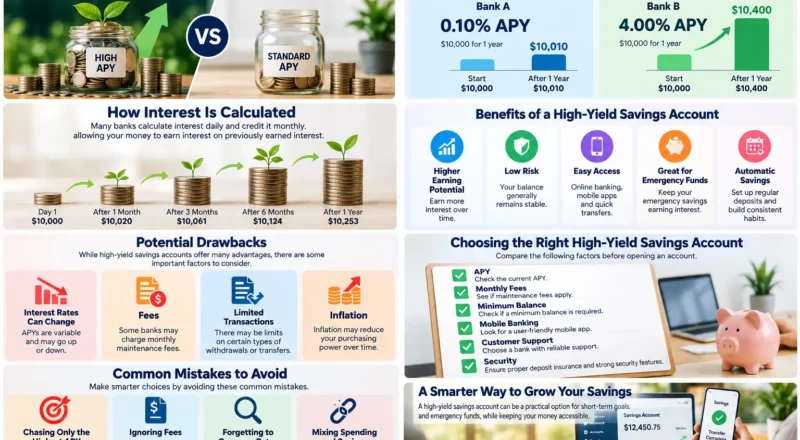
Imagine two banks:
Bank A
- APY: 0.10%
Bank B
- APY: 4.00%
If you keep the same amount of money in each account for a year, the account with the higher APY will generally earn significantly more interest.
When comparing savings accounts, APY is usually a better measure than the stated interest rate because it reflects compounding.
How Interest Is Calculated
Although every bank has its own method, many financial institutions:
- Calculate interest daily.
- Credit interest monthly.
This means your money can begin earning interest on previously credited interest, helping your balance grow over time.
Benefits of a High-Yield Savings Account
1. Higher Earning Potential
The biggest advantage is the opportunity to earn more interest than with many traditional savings accounts.
Over time, a higher APY can make a noticeable difference in how quickly your savings grow.
2. Low Risk
Unlike stocks or cryptocurrencies, money in a savings account does not fluctuate with market prices.
Your balance generally remains stable, making these accounts suitable for short-term goals and emergency savings.
3. Easy Access to Your Money
Most high-yield savings accounts let you:
- Transfer money electronically.
- View balances online.
- Use mobile banking apps.
- Set up automatic transfers.
This makes managing your savings convenient.
4. Emergency Fund Storage
Financial experts often recommend keeping emergency savings separate from your everyday spending account.
A high-yield savings account can help you earn interest while keeping those funds accessible if unexpected expenses arise.
5. Automatic Savings
Many banks allow recurring automatic transfers from a checking account.
For example:
- Weekly deposits
- Bi-weekly deposits
- Monthly deposits
Automating savings can make it easier to build consistent habits.
Potential Drawbacks
No financial product is perfect.
Here are some points to consider.
Interest Rates Can Change
High-yield savings account rates are variable.
Banks may increase or decrease their APYs depending on broader economic conditions.
Limited Transactions
Some banks may place limits on certain types of withdrawals or transfers.
Before opening an account, review the institution’s terms and conditions.
Inflation
Even if your savings earn interest, inflation may reduce your purchasing power over time.
For long-term wealth building, many people use savings accounts alongside other investment options, depending on their goals and risk tolerance.
Who Should Consider a High-Yield Savings Account?
A high-yield savings account may be suitable if you are:
- Building an emergency fund.
- Saving for a vacation.
- Planning a wedding.
- Saving for a home down payment.
- Preparing for college expenses.
- Setting aside money for taxes.
- Saving for a new car.
- Keeping cash for short-term goals.
It is generally less suitable for money you expect to invest for decades, where other financial products may be considered depending on your circumstances.
Choosing the Right High-Yield Savings Account
Before opening an account, compare:
APY
Look at the current APY, keeping in mind that rates can change.
Monthly Fees
Some institutions charge maintenance fees.
Others do not.
Minimum Balance
Check whether you must maintain a certain balance to earn the advertised APY or avoid fees.
Mobile Banking
A well-designed mobile app can make it easier to monitor and manage your savings.
Customer Support
Reliable customer service can be valuable if you need assistance.
Security
Choose a reputable financial institution that offers appropriate deposit insurance (where applicable) and strong account security features such as multi-factor authentication.
Common Mistakes to Avoid
Many new savers make avoidable mistakes.
Chasing Only the Highest APY
A slightly higher APY isn’t the only factor.
Also consider:
- Fees
- Customer support
- Ease of use
- Account features
Ignoring Fees
Even small monthly fees can reduce your earnings over time.
Forgetting to Compare Rates
Savings account rates change.
Review your account periodically to see whether it still meets your needs.
Mixing Spending and Savings
Keeping emergency savings separate from everyday spending can make budgeting easier.
Frequently Asked Questions
Is a high-yield savings account safe?
Eligible accounts at qualifying banks or credit unions are generally protected up to applicable insurance limits. Check the institution’s coverage before opening an account.
Can I lose money?
Unlike market-based investments, the account balance itself does not fluctuate due to stock market movements. However, fees or inflation can affect the overall value of your savings over time.
How often is interest paid?
Many institutions credit interest monthly, though practices vary.
Can I open more than one high-yield savings account?
Yes. Some people use multiple savings accounts to organize different financial goals, such as travel, emergencies, or major purchases.
Is a high-yield savings account better than a checking account?
They serve different purposes.
A checking account is designed for everyday spending, while a savings account is designed for storing money and earning interest.
Final Thoughts
A high-yield savings account can be a practical option for people who want to earn more on their savings while maintaining easy access to their money. It can be particularly useful for emergency funds and other short-term financial goals.
When comparing accounts, look beyond the advertised APY. Consider fees, account features, customer support, and the reputation of the financial institution. Choosing an account that aligns with your financial needs is often more important than chasing the highest rate alone.